

Leaving the civilized world behind for a few hours could be the healthiest thing you do all day


My Forest Bathing - The Rouge Valley
In a world filled with screens, notifications, and constant stimulation, many of us are searching for ways to slow down and reconnect—with ourselves and with the world around us.
One practice that has gained attention for its calming and restorative benefits is Shinrin-yoku, a Japanese concept often translated as forest bathing.
Despite the name, forest bathing doesn’t involve water. Instead, it refers to the practice of immersing yourself in nature using all five senses—allowing the sights, sounds, smells, and textures of the natural world to gently draw your attention away from the noise of everyday life.
Research has shown that time spent in natural environments can help reduce stress, muscle tension, and blood pressure, while also improving mood and overall wellbeing (Siah et al., 2023; Herchet et al., 2026).
But for me, discovering forest bathing wasn’t something that happened intentionally.
It happened slowly—one step at a time.
What Forest Bathing Really Looks Like

Unlike many wellness practices, there are no strict rules for forest bathing.
You don’t need special equipment.
You don’t need hours of free time.
And you don’t even need to live next to a forest.
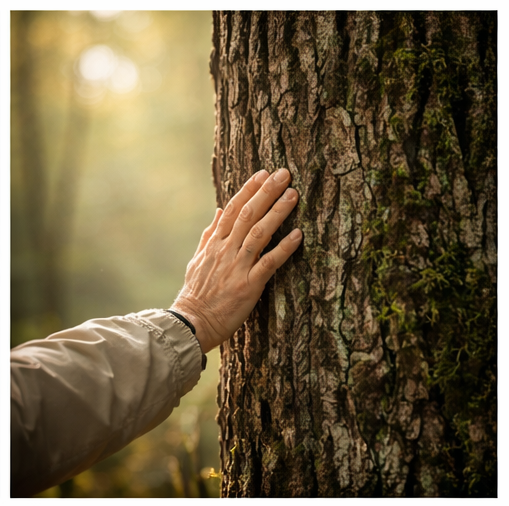
Sometimes it can be as simple as:
-
noticing the smell of damp earth after rainfall
-
listening to wind move through the branches
-
watching sunlight filter through leaves
-
feeling the ground beneath your feet as you walk
The goal isn’t exercise or productivity. It’s presence.
Research on forest bathing suggests that even relatively short periods of time in nature may promote relaxation and psychological restoration (Kotera et al., 2024)."
The Irony of How I Discovered It


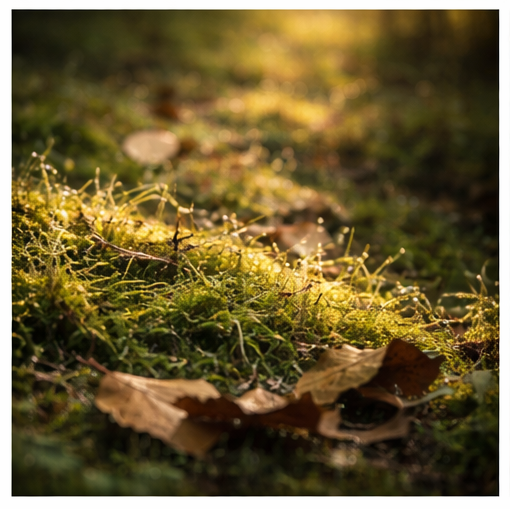
Photos from my time living in Japan in the late 1990s—taken years before I discovered the concept of Shinrin-yoku, or forest bathing.
The irony of discovering forest bathing later in life isn’t lost on me.
Years ago, I lived in Tokyo, one of the busiest cities in the world. At the time, my focus was simple: work hard, earn money, and make the most of the opportunity.
But the pace of life left little room for stillness.
The city was vibrant and exciting, but it was also overwhelming. Long hours and crowded streets made moments of quiet solitude rare. Often, even seeing a clear view of the sky felt difficult among the wires, buildings, and endless movement of the city.
Japan is actually where the concept of forest bathing began in the 1980s. Yet while living there, I never experienced it.
Three years passed, and the opportunity quietly slipped by.
Discovering Nature Right Outside My Door
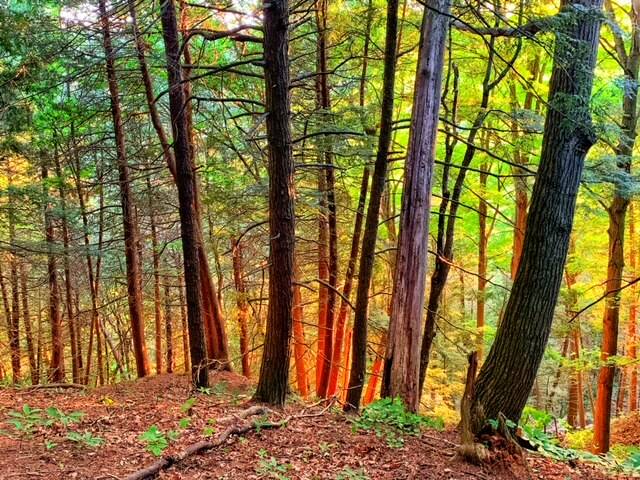
One of my walks in the Rouge Forest during sunset
Eventually I returned to Canada and settled into a home beside Rouge Forest in Pickering, Ontario.
For fifteen years, the forest was there - just steps away.
And yet, somehow, I rarely explored it.
It wasn’t until the beginning of 2020, when life suddenly slowed during the early months of the pandemic, that I finally began walking those trails.
What I discovered was something simple but powerful.
Nature had been waiting for me all along.
Those quiet walks became more than just exercise. They became moments to step away from my computer, breathe deeply, and reconnect with my surroundings.
Without realizing it, I had created my own version of forest bathing.
Why Nature Helps the Nervous System Reset

From a psychological perspective, nature offers something our nervous systems deeply need: safety and regulation.
Natural environments engage our senses through sights, sounds, scents, textures, and other sensory experiences (Buckley et al., 2024).
Time in natural environments can also support mental restoration and may reduce feelings of stress and anxiety (Herchet et al., 2026).
Nature slows us down in ways modern life rarely does.
Finding Your Own Version of Forest Bathing
You don’t need a large forest to experience the benefits.
Your version might look like:
-
a quiet walk through a local park
-
sitting beside a river or lake
-
wandering through a tree-lined trail
-
simply stepping outside and paying attention to the natural world around you
The important part isn’t distance or location. It’s allowing yourself the time to notice.

A Simple Invitation
It took me nearly two decades to realize that the calm and clarity I needed had been just outside my door.
Now, it’s something I try to return to regularly.
If life has been feeling overwhelming lately, consider stepping outside—even briefly.
You may discover that what your mind and body need most isn’t more effort or productivity.
Sometimes, it’s simply a quiet walk through the woods.
Many people today feel stuck in cycles of stress, anxiety, or emotional exhaustion. Sometimes the first step toward healing is simply learning how to slow down and reconnect—with yourself, your body, and the world around you.
Therapy can help you understand what your nervous system has been carrying and learn practical ways to restore balance and calm.
If you’re interested in exploring this work together, I invite you to reach out.
You don’t have to navigate it alone.
References
Buckley, R. C., Cooper, M.-A., & Zhong, L. (2024). Principal sensory experiences of forest visitors in four countries, for evidence-based nature therapy. People and Nature, 6, 2480–2493. https://doi.org/10.1002/pan3.10723
Herchet, M., Venený, M., Kauls, L., Mentzel, C., Krause, T., Surrey, C., & Hofmann, M. (2026). Mental health benefits of urban green—A systematic review and meta-analysis of 56 pre-post control experiments. People and Nature, 8(4), 808–834. https://doi.org/10.1002/pan3.70250
Siah, C. J. R., Goh, Y. S., Lee, J., Poon, S. N., Ow Yong, J. Q. Y., & Tam, W. S. W. (2023). The effects of forest bathing on psychological well-being: A systematic review and meta-analysis. International Journal of Mental Health Nursing, 32(4), 1038–1054. https://doi.org/10.1111/inm.13131
Vermeesch, A. L., Ellsworth-Kopkowski, A., Prather, J. G., Passel, C., Honegger Rogers, H., & Hansen, M. M. (2024). Shinrin-yoku 森林浴 (forest bathing): A scoping review of the global research on the effects of spending time in nature. Global Advances in Integrative Medicine and Health, 13, 27536130241231258. https://doi.org/10.1177/27536130241231258
