


Living with ADHD can sometimes feel like life is running on “hard mode.” Tasks pile up, time slips away, and even small responsibilities can feel overwhelming.
The problem usually isn’t motivation.
Many everyday challenges associated with ADHD involve executive functioning, including difficulties with attention, working memory, planning, and self-regulation (Cortese et al., 2025).
The good news is that ADHD brains respond very well to external structure, visible cues, and short tasks.
The following are a few simple systems that many people with ADHD find surprisingly effective.
1. The 90-Second Check-In

Reconnect with your body and your time using the 90-Second Check-In.
Before starting a task or transitioning to something new, pause briefly and ask yourself:
Body Check:
-
Am I hungry? Thirsty? Tired? Overstimulated?
If the answer is yes, address that first. Sometimes a snack, water, or a short break can restore focus.
Time Check:
-
Do I need to leave soon?
-
Is there something I should prepare for tomorrow?
People with ADHD may experience difficulties noticing or interpreting internal body signals and may also have differences in time perception. Taking a brief pause to check in with your body and schedule can provide a simple external cue for noticing these needs (Bruton et al., 2025; Metcalfe et al., 2024).
2. The 10-Minute Reset
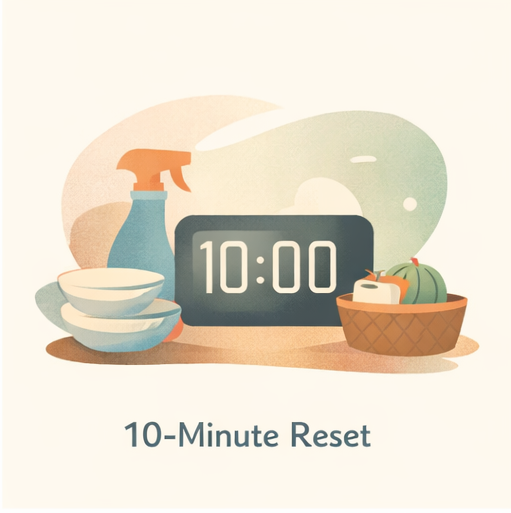
Prevent the “deep clean → avoid cleaning for weeks” cycle.
Instead of aiming for a big cleaning session, try a 10-minute reset.
Set a timer and focus on just three things:
✔ Clear visible surfaces
✔ Put dishes in the sink or dishwasher
✔ Pick up clutter from the floor
When the timer ends, stop.
Consistency matters more than perfection.
3. The 60-Second Rule
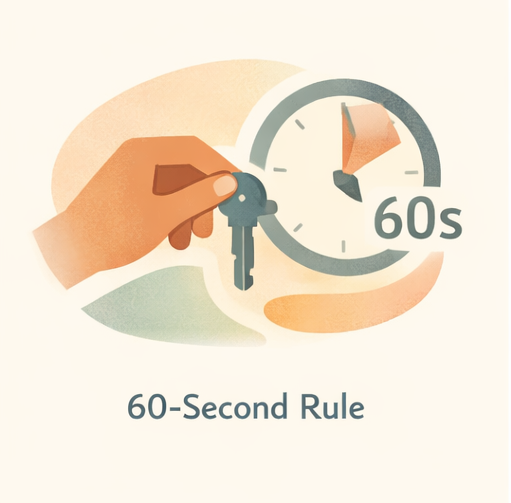
Stop clutter before it grows.
If a task takes less than one minute, do it immediately.
Examples:
-
Hang up your coat
-
Throw away packaging
-
Put dishes in the dishwasher
-
Put shoes away
These small actions prevent the clutter snowball that can overwhelm ADHD households.
4. The 5-Minute Daily Reset
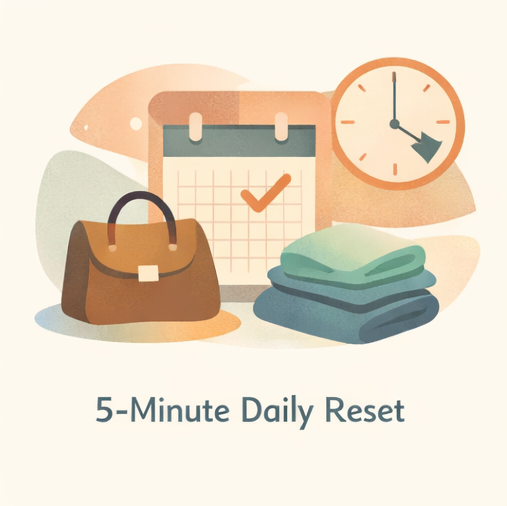
Prepare for tomorrow in just five minutes.
At the end of the day, ask yourself:
-
What one small task would make tomorrow easier?
-
Is there something I should prepare tonight?
Examples:
✔ Pack your bag
✔ Check tomorrow’s calendar
✔ Lay out clothes
✔ Load the dishwasher
Choose one task only. Completion builds momentum.
The Golden Rule

ADHD success usually comes from small consistent actions, not bursts of effort.
Focus on progress, not perfection.
Timers, reminders, and routines aren't crutches, they're tools that can provide external structure and make everyday tasks easier to manage for people with ADHD (Matsumoto et al., 2024).
Top 5 Tips for Living with ADHD
If ADHD is affecting your daily life, work, or relationships, therapy can help you develop strategies that work with your brain — not against it.
References
Bruton, A. M., Levy, L., Rai, N. K., Colgan, D. D., & Johnstone, J. M. (2025). Diminished interoceptive accuracy in attention-deficit/hyperactivity disorder: A systematic review. Psychophysiology, 62(2), e14750. https://doi.org/10.1111/psyp.14750
Cortese, S., et al. (2025). Attention-deficit/hyperactivity disorder (ADHD) in adults: Evidence base, uncertainties and controversies. World Psychiatry, 24(3), 313–329. https://doi.org/10.1002/wps.21374
Matsumoto, K., Hamatani, S., Kunisato, Y., & Mizuno, Y. (2024). Components of cognitive-behavioural therapy for mitigating core symptoms in attention-deficit hyperactivity disorder: A systematic review and network meta-analysis. BMJ Mental Health, 27(1), e301303. https://doi.org/10.1136/bmjment-2024-301303
Metcalfe, K. B., McFeaters, C. D., & Voyer, D. (2024). Time-perception deficits in attention-deficit/hyperactivity disorder: A systematic review and meta-analysis. Developmental Neuropsychology, 49(1), 1–24. https://doi.org/10.1080/87565641.2023.2293712